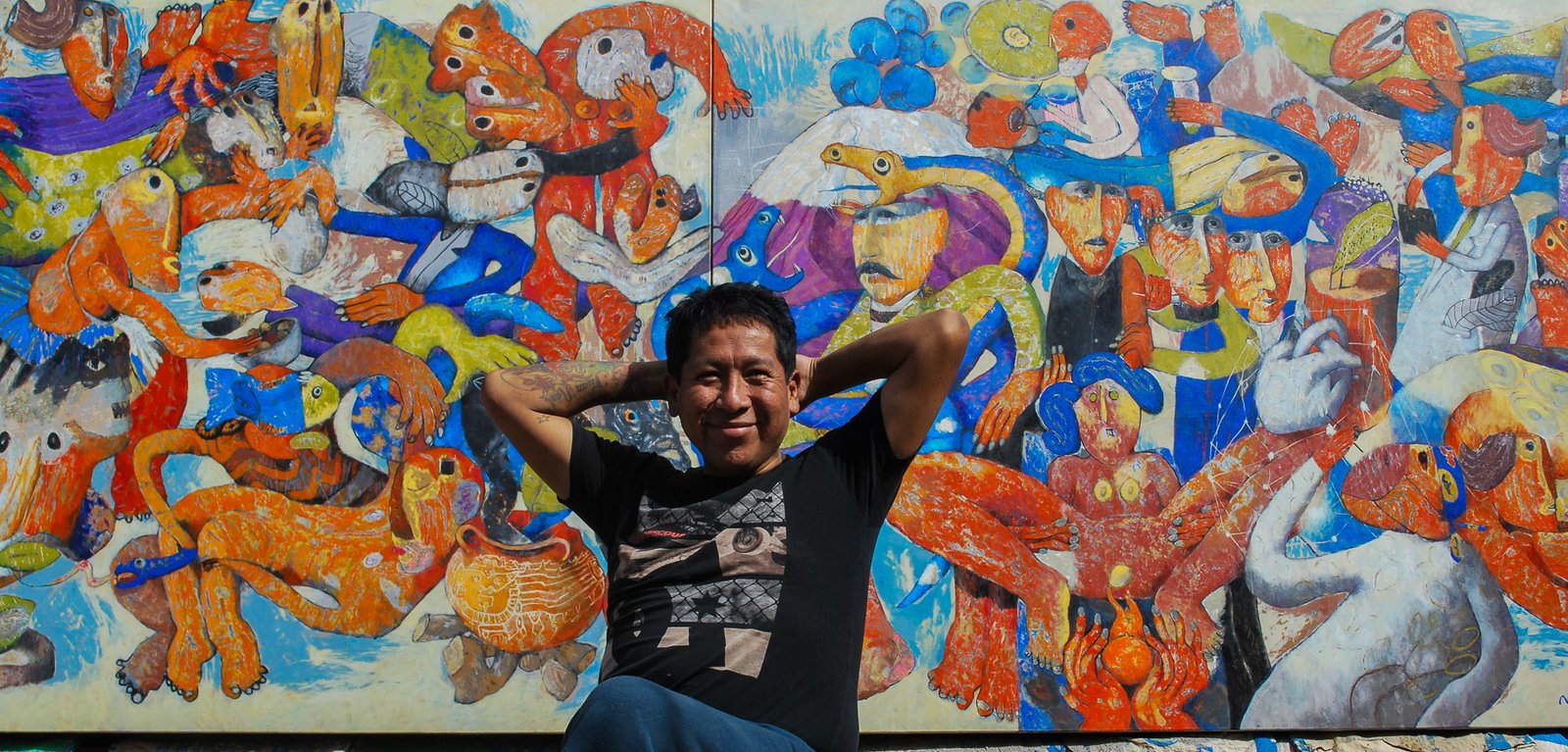
JUAN RAÚL MACHACA DE AQUINO, born in Arequipa yet shaped at his grandmother’s home in Puno during school breaks, has built his painting upon the living memory between his birthplace and ancestral land. His art bridges early school years seated upon a block of volcanic sillar stone in a roofless "classroom" without a blackboard, and his youthful efforts to turn that modest pueblo joven school—through tireless donations—into today’s modern “Carlos Manchego” school in the consolidated settlement of 4 de Octubre, where he was raised.
The Forging of a Pictorial Language
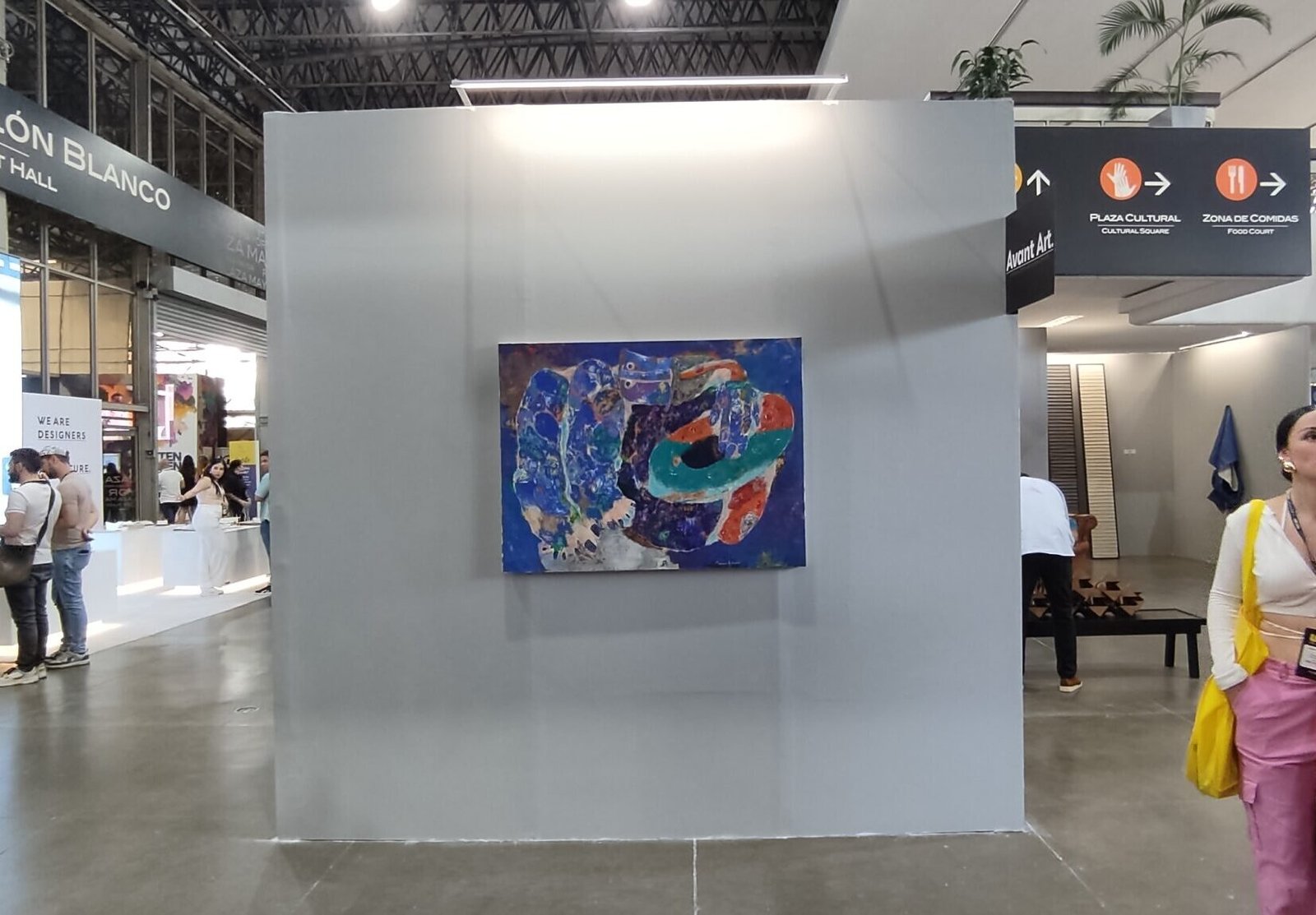
In this coming and going—among his grandmother’s myths and tales, and the sweet-vendor’s basket at the vacant corner of his school block—he discovered the material that now fills his exhibitions. In his search for an authentic visual language, and after thorough distillation, he incorporated elements such as fruits, tubers, and vegetables of the Pachamama, spinning tops and lollipops from the schoolchildren's treats, and the small plaster masks from the traditional bread guaguas of Arequipa’s November festivities.
Vocation and Identity
It seems anecdotal at first, yet deeply meaningful over time, that he resolved to become a painter at age fifteen upon reading a newspaper notice for the exhibition opening of Víctor Turpo Machaca. From that day on, he determined to follow Turpo, whom he claimed as an uncle and guiding light. Yet it goes beyond mere anecdote: what Juan Raúl found was not only a vocation, but a profound anchor of identity and belonging—his “uncle” was a Machaca, a painter from Puno featured in the press.
From the Countryside to the Humanized Still Life
Throughout his fine art studies at the Universidad Nacional de San Agustín and upon graduating, his daily dedication was plein air painting. The proximity of his home to the countryside of Socabaya—the traditional district encompassing 4 de Octubre—nurtured his exploration of landscape, a foundational subject of the renowned Arequipa watercolor school. Over the years, however, the still life became his defining genre, evolving in the way elements inhabit and populate his compositions.
This transformation progressed from still lifes where native fruits and tubers took on the guise of musical instruments or wheeled objects—sharing space with playing cards and field mice—to “humanized” fruits of the earth, crowned with the delicate plaster masks preserved after savoring the traditional bread guaguas baked in Arequipa for All Saints’ Day.
The Universe of Symbols
Thus personified, his harvest is accompanied by objects of distinct symbolism: playing cards representing fate and fortune; paper boats evoking journeys and youthful flights from the family home; watermelons embodying the carousel of existence; and open-mouthed fish, the sole animate beings. Eventually, the fruits sprout diaphanous wings, cards turn into traffic signals, boats become cattle, and fish metamorphose, sharing form with bananas or sweet potatoes.
Maturity: The Best Memory
Juan Raúl Machaca de Aquino has reached that creative maturity where one embraces who one is and the land to which one belongs. Painting becomes the vessel for this truth, stated directly in artwork titles and channeled symbolically—even with candid gentleness—into his canvases. Though bringing together seemingly incongruous objects, his compositions are charged with the poetic magic of a childhood lived between two worlds.
The Candelaria festival, the grandmother and her oral legends, the dances of Puno and Bolivian folklore, the childhood games with masks upon the school’s dirt courtyard... all are revived memories revolving around the sacred figure of the mother: The Best Memory, Josefa, generously shared through the expressive freedom of art. The best I remember, Josefaand that shared by the license that is granted by art.